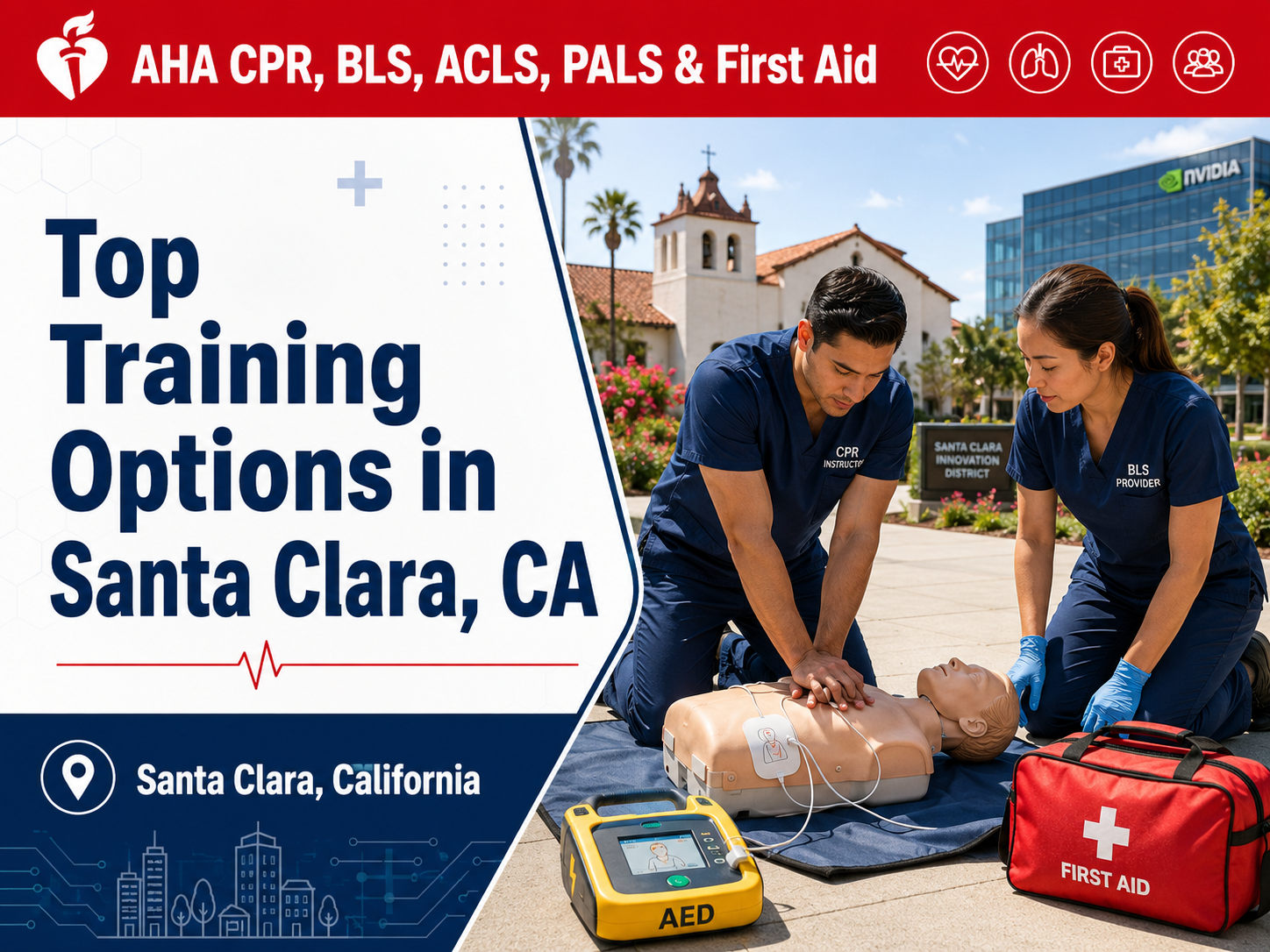
Santa Clara’s workforce is unusual in that three very different employer types sit within a few miles of each other: large event venues, Santa Clara University, and a dense cluster of tech campuses. Each tends to have its own expectations around CPR training, and those expectations aren’t always the same course. Stadium and event staff often need general CPR and AED readiness, university departments vary by role, and tech-campus safety teams frequently require the American Heart Association’s BLS (Basic Life Support) course specifically. This guide sorts out which certification typically applies to which role, what a BLS class actually involves, and how to fit training around shift schedules or a busy semester.
Key Takeaway
The right certification in Santa Clara usually depends on your specific role rather than your employer type alone: stadium and general event staff often need standard CPR and AED training, while university health-services staff and tech-campus safety or clinic teams are more likely to require BLS. Confirming this with your supervisor before registering prevents booking the wrong course.
BLS or Standard CPR? Matching the Certification to Your Role
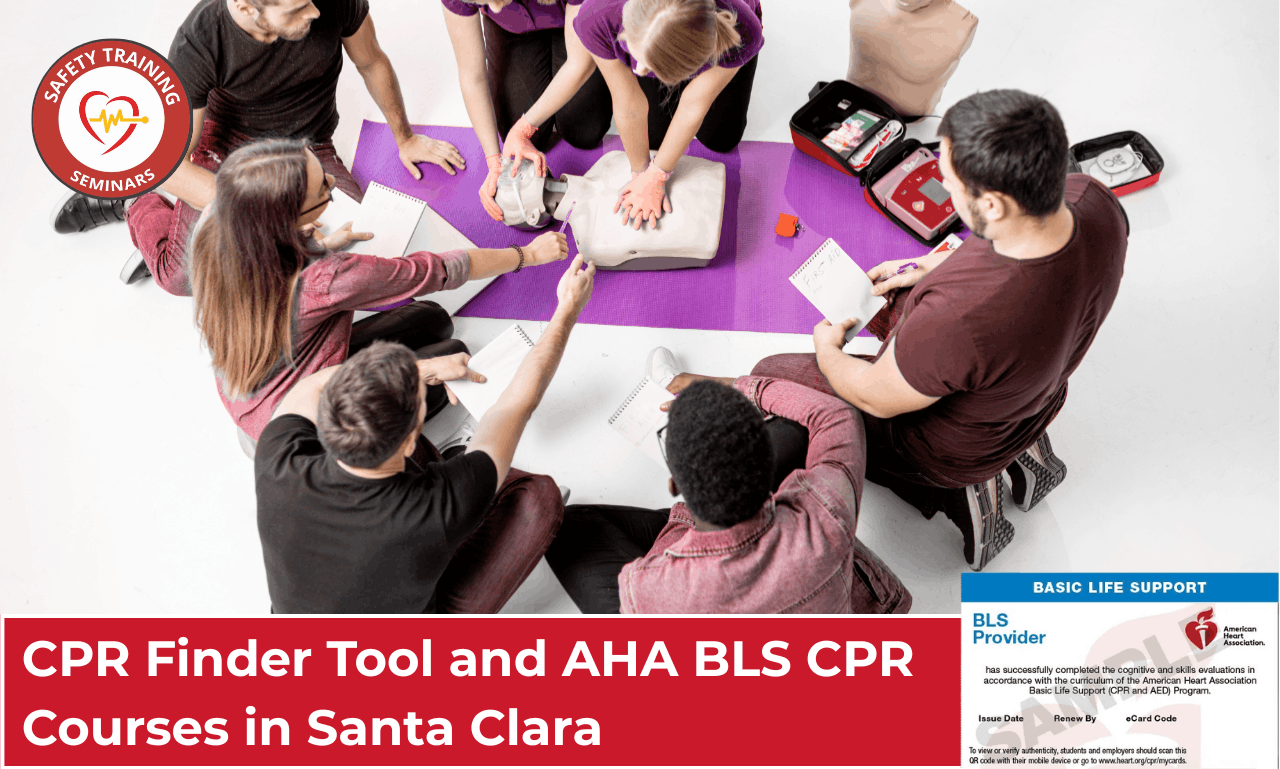
BLS is the American Heart Association course built for people who may respond to cardiac or breathing emergencies in a healthcare or clinical-adjacent setting. It includes team-based resuscitation skills, AED use, and airway management, and it requires a supervised skills test rather than an online-only completion.
Standard CPR and First Aid training covers similar hands-on skills — adult, child, and infant CPR, choking response, and basic first aid — but is built for general workplace safety rather than clinical response. Most event-venue staff, office employees, and general administrative roles fall into this category. A general CPR card usually won’t satisfy a job requirement that specifically calls for BLS, so it’s worth checking your role’s exact wording before enrolling.
What Stadium and Large-Event Staff Typically Need
Large event venues in Santa Clara often build CPR readiness into their staff safety policy, particularly for guest-services, security, and operations teams working large crowds. In most cases this means standard CPR and AED training rather than BLS, since these roles focus on initial response and AED access rather than clinical-level care.
Medical staff or contracted emergency responders working events are more likely to need BLS specifically, since their role may involve coordinated resuscitation efforts alongside paramedics or on-site medical teams. If you’re unsure which category your position falls into, your venue’s safety or HR coordinator can typically confirm which certification level applies.
Which Santa Clara University Roles Typically Need BLS?
Health-services staff, athletic trainers, and some science-lab or clinical-adjacent departments at Santa Clara University are the roles most likely to require BLS, often tied to campus health and safety policy or licensure requirements for specific positions. General administrative, facilities, and academic staff are less likely to need BLS unless their department has its own policy requiring it.
Because university requirements can differ by department and sometimes by supervisor, checking with your specific office before registering is the most reliable way to confirm which certification applies. Staff supporting student health services in particular should expect BLS to be the default requirement rather than the exception.
Tech-Campus Safety Teams and On-Site Health Services
Santa Clara’s tech campuses frequently include designated safety responders, security teams, and in some cases on-site health clinics, and BLS tends to be most relevant for these specific roles rather than the general employee population. A wellness-center nurse or a formally designated emergency responder is far more likely to need BLS than someone in a standard office role.
General tech-campus employees more often complete standard CPR and First Aid training as part of a broader workplace safety initiative, covering the same core skills without the clinical-team components BLS includes. If your employer’s policy doesn’t specify a certification type, asking HR directly avoids the guesswork.
What Happens During the BLS Skills Test
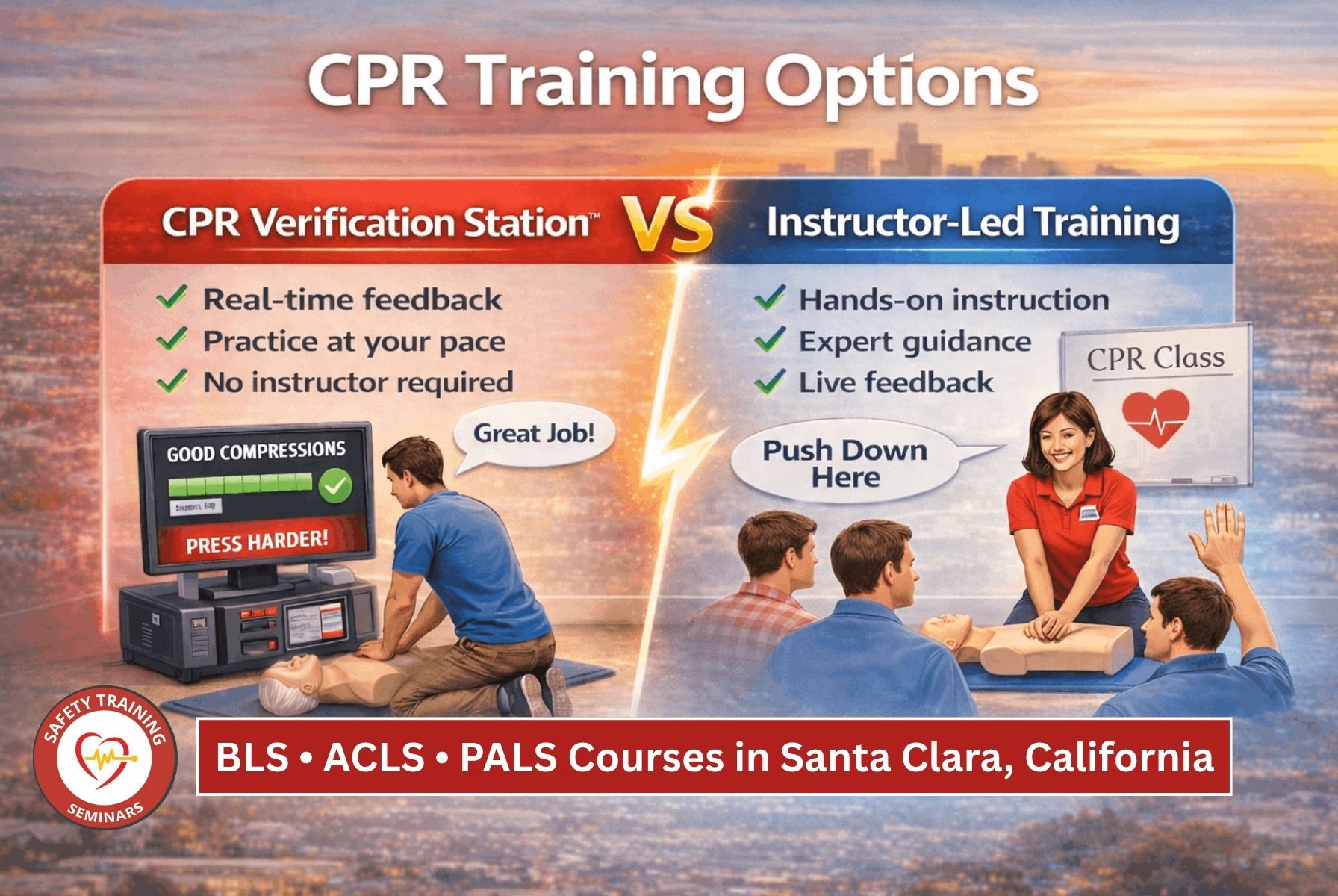
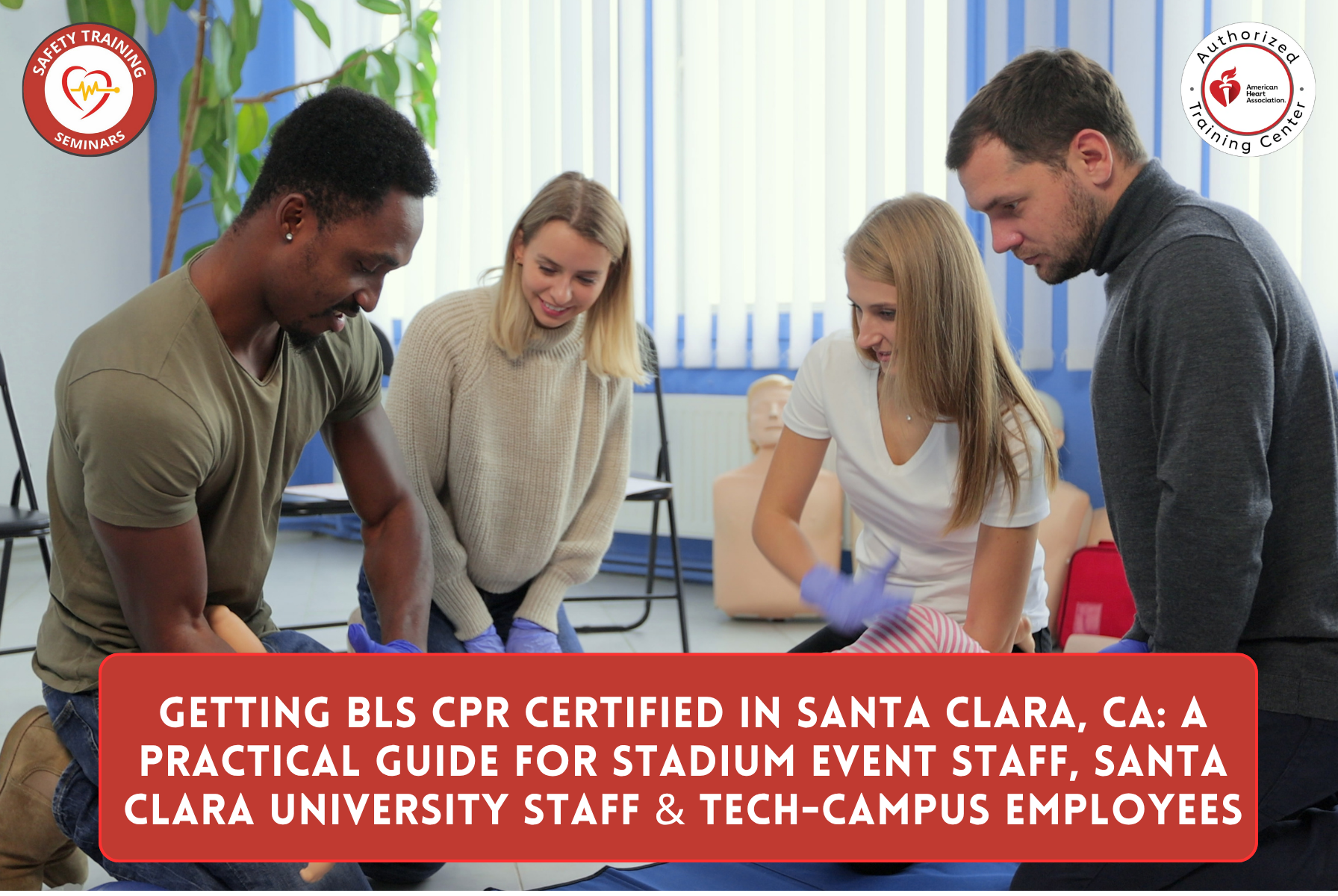
Once the classroom or online knowledge portion is complete, BLS certification requires a hands-on skills test where an instructor evaluates your technique directly. You’ll demonstrate chest compressions, rescue breaths, and AED use on a manikin, along with airway-obstruction response for adult, child, and infant scenarios.
This in-person or live-supervised component is what separates BLS from courses completed entirely online. A fully self-paced certificate without a skills evaluation typically isn’t accepted for BLS purposes, which is worth knowing if your employer or department specifically requires the AHA BLS Provider designation.
Choosing Between In-Person and Blended Formats
For shift-based stadium staff, university employees balancing academic-year schedules, and tech workers with unpredictable meeting loads, the format decision usually comes down to available time rather than preference alone.
A blended course lets you complete the knowledge portion online and attend only a shorter in-person session for the skills test, which tends to work well around irregular shifts or a packed calendar. A traditional in-person class remains a good option for anyone who’d rather finish training in one sitting. Both paths lead to the same AHA BLS Provider certification once the skills test is complete.
Training Access Across the South Bay
Santa Clara’s employee base draws heavily from surrounding South Bay communities, and commute patterns often shape which class location makes sense. Someone working a stadium event or split shift may prefer a class scheduled outside standard business hours, while a university or tech-campus employee might look for a location closer to home rather than campus.
Readers commuting from Cupertino or Campbell sometimes find it more practical to attend a class along their commute route rather than adding extra driving time before or after a shift. The same often holds for employees traveling from Los Gatos, Milpitas, or Monte Sereno.
Where to Complete BLS Training Near Santa Clara
Safety Training Seminars operates a training center in Santa Clara, located at 1400 Coleman Avenue, Suite E18-1, Santa Clara, CA 95050, offering BLS certification for clinical and safety-team roles along with general CPR and First Aid classes for broader workplace requirements. Reviewing which certification your role requires before registering helps avoid attending the wrong course.
Employees or students commuting from further south may find it useful to check the Gilroy CPR and BLS class page or the Los Altos Hills CPR and BLS class page for scheduling closer to those areas.
Frequently Asked Questions
Do stadium and event-venue staff in Santa Clara need BLS certification? Most guest-services, security, and operations roles at large venues need standard CPR and AED training rather than BLS, since these positions focus on initial response. Medical staff or contracted responders working events are more likely to need BLS specifically. Your venue’s safety coordinator can confirm which level applies to your role.
Which Santa Clara University employees are usually required to hold BLS? Health-services staff, athletic trainers, and some clinical-adjacent departments are the roles most commonly required to hold BLS certification. General administrative and facilities staff typically aren’t required to unless their specific department has its own policy, so checking with your office directly is the most reliable approach.
Is an online-only CPR certificate accepted for a BLS requirement? Generally, no. BLS certification requires a supervised skills test where an instructor evaluates your compressions, rescue breaths, and AED use in person or through a live-supervised session. A fully self-paced course without this component typically isn’t accepted for BLS credentialing.
How long is BLS certification valid once completed? AHA BLS certification is generally valid for two years from the date of course completion. Some employers set internal renewal deadlines earlier than that, so it’s worth confirming your specific timeline with your department or HR office rather than relying solely on the date on your card.
Can Santa Clara employees attend a CPR or BLS class in a nearby city instead? Yes, in many cases. Because commute patterns vary widely, some employees prefer scheduling closer to home or along their regular commute route rather than attending in Santa Clara itself. Checking nearby course-location pages directly confirms current availability.
Deciding on the Right Course Before You Register
Santa Clara’s mix of stadium, university, and tech-campus employers means the same job title can carry different certification requirements depending on the role and department. The most useful step before enrolling is confirming with your supervisor or HR office whether BLS or standard CPR applies to your position, since the two aren’t interchangeable for clinical or policy purposes. From there, choosing between an in-person or blended format usually comes down to your shift pattern or calendar that month. Safety Training Seminars’ Santa Clara location offers both course types, and reviewing the details before booking helps make sure the class fits what your employer or department actually requires.